
Step into a massive warehouse on a sizzling 40°C day and experience the heat! Feel like an oven? You’re not alone. Witness workers wilting in Perth’s intense heat; this is where having the right cooling system is crucial. Opt for the industrial evaporative cooler: a supersized swamp cooler designed for factories, hangars, and gymnasiums.
These units sit on rooftops or walls, pumping clouds of chilled, fresh air into the space. In dry climates like Perth’s, they’re absolute game changers. Instead of recirculating stale indoor air, an industrial evaporative cooler draws outside air through water soaked pads.
The water evaporates, dropping the air’s temperature by up to 10–15°C , then blasts it into your huge space. The result? Big energy savings, cooler floors, and happier people.
Industrial evaporative coolers mounted on a large warehouse exterior. several of these powerful units on your roof or wall each one working to flood a factory with cool, moist air.
In practice, you could line up multiple industrial evaporative coolers to cover thousands of square meters.
Energy Efficiency and Huge Savings
Running an industrial evaporative cooler in a big space can feel like magic; it slashes energy use. These systems use only a fan and pump, so they consume only about 20% of the electricity of a comparable refrigerated AC.
In fact, some industrial evaporative coolers run on 82% less power than a traditional air conditioner. This adds up to huge savings on your power bill, often up to 75–80% cheaper to run over a year.
- Low Energy Use: With simple fans and water evaporation, an industrial evaporative cooler is green on your meter. For example, a ducted AC might use ~5 kW to cool a warehouse, whereas an equivalent industrial cooler may only draw ~1 kW. Studies show this translates into massive electrical savings.
- Easy on the Wallet: Perth’s summer electricity bills are notorious. Cutting usage by ~80% can save thousands. One case study found switching to evaporative cooling yielded a 75% drop in annual energy use (about $24.8k saved). You’ll stay cool, but your wallet won’t break a sweat.
- Water vs. Electricity: Yes, evaporative coolers do use water roughly 100 liters per hour in Perth’s heat (around 30,000 L per summer). Even so, that water cost is usually a tiny fraction of the saved electricity. By using efficient bleed-off settings and regular service, you enjoy big energy cuts without a huge water bill.
- Scaling with Mini/Multi-Splits: A mini split air conditioner can cool a single zone, and a multi-split system air conditioner ties several zones to one outdoor unit. Covering a huge warehouse this way would require dozens of units, using enormous power.
One industrial evaporative cooler, by contrast, floods the whole space for a fraction of the equipment and power.
Notice how the industrial evaporative cooler dominates for big spaces: it cuts power bills and floods the air with a cold breeze where you need it. The table below highlights the differences:
|
Aspect |
Industrial Evaporative Cooler |
Multi-Split System Air Conditioner |
Mini-Split Air Conditioner |
|
Energy Use |
Very low (~20% of AC) | High (baseline 100%) | Moderate per unit (many needed) |
| Air Quality | 100% fresh, filtered outside air | Mostly recycled indoor air |
Recycled indoor air |
|
Best For |
Large open areas, hot-dry climates | Multi-zone cooling in varied climates | Single rooms or small offices |
| Installation | Roof/wall-mounted; simple ducting | Multiple indoor units; complex ducts |
One indoor unit per space |
|
Running Cost |
Very low (huge power savings) | High (lots of electricity) | High (many units drive cost) |
| Maintenance | Annual pad cleaning; long life (15–20 yr) | Refrigerant servicing; ~10–15 yr lifespan |
Filter cleaning; ~10–15 yr life |
By the numbers, the industrial evaporative cooler wins: it uses far less energy and provides 100% outdoor air (filtered), whereas AC systems use much more power and mostly recirculate indoor air.
Fresh Air and Environmental Perks
An industrial evaporative cooler does more than lower temperature; it boosts air quality. Because it pulls 100% fresh outside air through a filter pad, your workforce breathes cleaner air. Imagine it as your warehouse’s personal air filter, trapping dust and pollen, making the shop floor a true oasis of fresh air.
Plus, it’s an eco-warrior’s dream. These coolers use no toxic refrigerant just water. They can cut carbon emissions by up to ~80% compared to refrigerated AC. In other words, switching to evaporative cooling is like trading a gas-guzzling truck for an electric scooter when it comes to greenhouse impact.
- No Harsh Chemicals: Traditional AC units rely on refrigerants. Industrial evaporative coolers only use water no risk of leaks or ozone depletion.
- Lower Carbon Footprint: With far lower electricity use, they produce far less CO₂. One analysis shows evaporative systems generate 86% less carbon emissions than standard AC under similar conditions.
- Cool and Moist: In Perth’s dry heat, adding a touch of humidity feels nice. These coolers make the air a bit more comfortable , without feeling muggy just like a breeze by the ocean.
An industrial evaporative cooler unit delivers powerful cooling with minimal fuss. Plumping one of these into your hot facility is like turning on a mountain breeze. Because the units are often roof-mounted, they free up indoor wall space and keep the heat-exchange outside.
Easy Maintenance and Long Life
Maintenance is surprisingly simple. There’s no compressor or copper coils to service. Mostly, you just keep the pads clean and water flowing. A licensed technician can do an annual summer check to avoid dust or algae. It’s much easier than servicing a complex AC system.
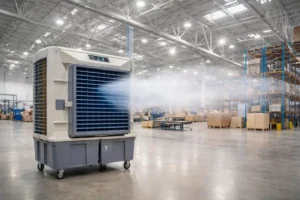
industrial evaporative cooler
Thanks to the simple design, an industrial evaporative cooler often outlives typical AC units. In Perth, a well-maintained cooler can run 15–20+ years. That’s decades of reliable cooling, with inexpensive parts when you do need replacements. In contrast, ducted refrigerative systems often hit major repairs or replacement sooner.
Why It’s Perfect for Perth’s Summer
Perth’s climate is hot and dry, exactly the scenario evaporative coolers thrive in. Most afternoons the air’s humidity stays low, so water evaporation works brilliantly. On a 38°C day with 40% humidity, an industrial evaporative cooler can easily drop the hall temperature into the low 20s.
Local experts note that for Western Australia’s weather, evaporative systems are “cost-effective, energy efficient and environmentally friendly,” according to the Energy Efficiency Council. Installation tends to be simpler too you typically put the unit on the roof or high wall, which is much quicker than running complex ducts for a refrigerated system.
In contrast, standard ducted AC or split systems struggle in these conditions. A multi split system air conditioner still runs on copious electricity. Even if you lined your warehouse ceiling with mini-split AC units, they’d use far more power and still not match the evaporative cooler’s airflow.
When it’s a huge space vs. one cooling powerhouse, Perth’s pros usually bet on the evaporative cooler it’s like using a fire hydrant to put out a bonfire instead of a garden hose.
Conclusion
In a nutshell, industrial evaporative coolers are a smart upgrade for anyone managing large, sun-baked spaces. They slash energy bills, deliver fresh filtered air, and fit Perth’s climate perfectly.
The next time your warehouse feels like an oven, remember there’s a greener way to chill it: think water, not just watts.
Ready to beat the heat? Chat with a local cooling specialist about installing an industrial evaporative cooler on your roof. Your staff and your power meter will thank you.
FAQs
-
What is an industrial evaporative cooler?
It’s a large-scale cooling unit (often roof-mounted) that cools air by evaporating water, making it ideal for factories or big halls.
-
How does evaporative cooling differ from air conditioning?
Evaporative coolers use water and fans to cool and replace air, whereas AC uses refrigerant and typically recirculates indoor air.
-
Are evaporative coolers good for Perth’s climate?
Yes. Perth’s hot, dry summers are perfect for evaporative cooling, maximizing efficiency and comfort.
-
How much can I save with an industrial evaporative cooler?
Running costs are often 75–80% lower than refrigerated AC, thanks to the minimal electricity usage.
-
Do industrial evaporative coolers require a lot of maintenance?
Not really. You mostly clean or replace the pads annually and check water lines. They’re simpler to maintain than complex AC systems.
-
Can I use a mini split or multi split system instead?
Mini-split or multi-split ACs cool smaller zones well, but they usually aren’t as efficient or economical for huge open spaces. An industrial evaporative cooler generally handles large areas far better.
